Hey everyone, thanks for swinging by my little corner of the web. If you’re here, odds are you’re either deep in the weeds of designing electronics, or you’ve been Googling why your device is acting wonky with EMI (you know, that weird static or signal bleed that drives engineers nuts). Today, I’m gonna break down something I get asked about nonstop at work—specifically, the core materials we use for common mode inductors, and what makes each one tick. Full transparency: I’m a common mode inductor supplier, so this is stuff I deal with every single day, not just textbook theory. No jargon overload, I promise—we’ll keep it real. Common Mode Inductor

First, let’s do a quick refresh on what a common mode inductor even does, just to make sure we’re on the same page. It’s that little component that sits on data lines (USB, HDMI, Ethernet) or power lines, filtering out common mode noise—all that interference that hits both lines at the same time. Without it, your phone screen might flicker, your Wi-Fi might cut out, or even a power supply might overheat. And the core material is the backbone of this whole thing. If you pick the wrong one, your inductor won’t work as hard as it should, or it’ll get too hot, or it’ll be way more expensive than it needs to be. I’ve seen way too many clients come to us after messing up that first part, so let’s dive into the main ones we use: ferrite, powdered iron, nanocrystalline, and sendust.
Let’s start with ferrite—this is the OG, the workhorse of common mode inductors. 9 out of 10 inductors you see on the market use ferrite cores, and for good reason. What’s its big thing? It’s super permeable at lower frequencies, right? So at the kHz to low MHz range, it can crank up inductance without being huge. That’s perfect for low-noise, low-power apps like USB chargers, small Ethernet modules, or audio gear. But here’s the catch: ferrite loses its mojo at higher frequencies, like above 10 MHz or so. It gets what’s called “eddy current loss” and “hysteresis loss”—basically, it heats up and doesn’t filter noise as well. Also, it’s brittle. If you drop a component with a ferrite core, it might crack, and that ruins its performance. I’ve had a client send back a whole batch because their assembly line was dropping parts, and half the ferrite cores were split. It’s not the end of the world, but you gotta handle it with a little care. Also, ferrite comes in different grades—like manganese-zinc (MnZn) and nickel-zinc (NiZn). MnZn is for lower frequencies, super high permeability, great for power lines. NiZn is for higher frequencies, like 10 to 100 MHz, because it’s more resistant to loss there. We stock both, but we always ask clients what frequency range they’re targeting before we suggest ferrite, because it’s not a one-size-fits-all.
Next up, powdered iron. This one’s a step up from ferrite when it comes to higher frequencies, but it’s different from ferrite in how it’s made. Powdered iron is tiny iron particles, each coated with an insulator, pressed together into a core. That insulation between the particles cuts down on eddy current loss way more than solid ferrite, so it works better at higher MHz ranges, like 10 MHz to 100 MHz. It’s also way tougher than ferrite—you can drop it, knock it around a little, and it won’t crack. That’s a big plus for industrial apps or automotive stuff, where components get banged around. But the downside? It’s less permeable than ferrite. So to get the same inductance, you need a bigger core. That might not matter for a big power supply, but it’s a dealbreaker for tiny compact devices like wireless earbuds or smartwatches, where every mm counts. Also, powdered iron has higher “DC bias” performance—wait, what’s that mean? If you’re running a lot of current through the inductor, it doesn’t lose as much inductance as ferrite does. So for power lines that carry higher DC current, powdered iron is solid. We use a lot of powdered iron for automotive common mode inductors, because those cars have tons of electronics, and they need parts that can handle vibration, current, and higher frequency noise.
Now, nanocrystalline. This is the newer, fancy kid on the block, and it’s been blowing up the last 10 years or so. Let’s get this straight: nanocrystalline cores are made from a special alloy that’s heated and cooled really fast, making tiny crystal particles (like 10-20 nanometers big—way smaller than what you’d get in ferrite or powdered iron). What makes it awesome? It has super low loss across a huge frequency range—like from 10 kHz all the way up to 1 GHz. That’s unheard of for most materials. It also has great permeability, so it can have a small core size even with high inductance, and it handles DC bias way better than both ferrite and powdered iron. Oh, and it’s efficient—so it doesn’t heat up even when working hard, which is huge for power apps where heat kills performance and lifespan. But the catch? It’s way more expensive than the other two. Like, 2 to 5 times more. So you don’t use it for everything—only when you need that premium performance. For example, high-speed data lines like 10G Ethernet, or industrial robotics where reliability is non-negotiable, or 5G antennas. I’ve had telecom clients come to us for nanocrystalline common mode inductors for their base stations, because they need to filter super high frequency noise without taking up too much space. It’s not cheap, but it’s worth it for those high-stakes apps. And it’s way more durable than ferrite—no cracking, stands up to temperature swings way better, like from -40°C to 125°C. That’s perfect for outdoor gear, too.
Last one: sendust. Wait, I don’t hear people talking about sendust as much these days, but it’s still a big player for specific use cases. Sendust is an alloy of iron, silicon, and aluminum, made into powdered cores just like powdered iron. Its superpower is really high permeability at mid-range frequencies (like 1 kHz to 1 MHz), and it has even lower loss than powdered iron there. It’s also got great DC bias, better than ferrite, and it’s more stable across temperature than ferrite. But why isn’t it more common? It’s harder to manufacture, so it’s a bit pricey too, and it doesn’t perform as well at super high frequencies like nanocrystalline or even NiZn ferrite. We use sendust for some low-to-mid frequency power apps where the client needs better stability than ferrite gives them, but doesn’t want to splurge on nanocrystalline. Like, for some medical devices, where temperature consistency is key, and you don’t want inductance to drop off when the device gets warm.
Now, let’s talk about how I actually choose which core to suggest to a client, because I don’t just ramble about materials all day (well, sometimes I do, but I also get stuff done). First question: what’s the frequency range of the noise you’re filtering? If it’s low frequency (like under 5 MHz, power lines, basic USB), ferrite is almost always the sweet spot. It’s cheap, small enough, works great. If it’s mid-to-high frequency (10 MHz to 100 MHz, Ethernet, automotive data lines), powdered iron is the go-to for most, unless they need super high efficiency, then nanocrystalline. If it’s really high frequency (100 MHz up to 1 GHz, 5G, high-speed data), nanocrystalline or NiZn ferrite. Second question: how much current are you running through it? DC bias is huge here. If it’s high current, ferrite might not hold its inductance, so we go with powdered iron or nanocrystalline. Third question: how tight is your size constraint? If it’s a tiny wireless device, we’ll push for nanocrystalline even if it’s more expensive, because the smaller size is worth it. If it’s a big power supply, ferrite or powdered iron is fine. And fourth: environment. If it’s going in a car that vibrates, or outside in the cold and heat, no ferrite—too brittle. Go for powdered iron or nanocrystalline. If it’s a cheap consumer gadget that’ll never be dropped, ferrite works.
Wait, let’s throw in a real quick example to make this concrete. Last month, a client came to us designing a new 10G Ethernet switch. They were having noise issues that made the connection drop constantly at 10G speeds. They first tried NiZn ferrite cores, but at 100 MHz+, ferrite was losing inductance, so noise was getting through. Then they tried powdered iron, but the core was too big to fit in their slim switch design. We suggested nanocrystalline cores—they were a bit more expensive, but the core size was half what powdered iron would be, and the noise filtering was perfect. A week later, they sent us a note saying the switch was passing all stress tests, and they were ramping up production with our inductors. That’s exactly the kind of call we love to make—matching the right material to the right need, not just pushing the most expensive stuff.
I also wanna mention that core material isn’t the only thing—wait, but it’s the biggest variable. The same inductor design with a ferrite core vs a nanocrystalline core is two totally different parts. I’ve seen clients get burned by cheap inductors with cheap ferrite cores that crack after a month in the field, or inductors with powdered iron that are way too big for their design. That’s why we always do a sample first, right? We send a prototype with the right core material, test it, tweak it if needed, before committing to a big order.
Before I wrap this up, let’s clear up a common myth. A lot of people think “bigger core = better filtering.” No, that’s not true. The core material is way more important than size. A small nanocrystalline core can filter more noise than a big ferrite core, because of its material properties. That’s game-changing for compact electronics.
So if you’re working on a project right now, and you’re stuck on which common mode inductor to use, or you’ve been having issues with noise, heat, size, or durability—hit us up. We can walk through your frequency, current, size, and environment needs, and suggest the right core material for your application. No pressure, no sales fluff, just straight talk about what’ll work best for your project.
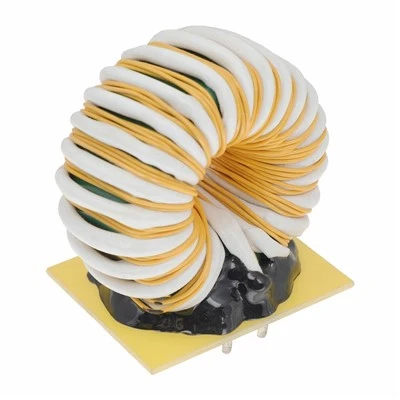
And one last thing: if you’re a designer or engineer who hates EMI as much as I do, feel free to reach out with questions. I’m always happy to nerd out about core materials or inductors in general.
Transformer References:
- Engineering Materials and Applications for Power Inductors, IEEE Transactions on Magnetics
- Common-Mode Choke Design and Application Guide, Texas Instruments
- Nanocrystalline Soft Magnetic Materials for High-Frequency Power Electronics, Journal of Applied Physics
- Iron Powder Core Technology for EMI Filtering, Mobile Power Magazine
- Ferrite Core Selection for RF and EMI Applications, Microwave Journal
Dongguan Hensiron Electric Co., Ltd.
As one of the most professional common mode inductor suppliers in China, we have world-leading production equipment and strong manufacturing capabilities. Please feel free to buy high quality common mode inductor made in China here from our factory. Customized orders are welcome.
Address: Building 4, Xinxing Industrial Zone, Wangao Road, Wanjiang Street, Dongguan City, China
E-mail: jessica@dghensiron.com
WebSite: https://www.dghensiron.com/
